Anchovy
Role:
Interviews, Onboarding Redesign, & Visual Layers
Interviews, Onboarding Redesign, & Visual Layers
Overview:
April 2025 - Current
April 2025 - Current
Led user research initiatives that directly informed product strategy and feature development. Designed comprehensive interview protocols and synthesized mixed-methods analysis combining qualitative interviews with quantitative survey data. Delivered actionable insights to cross-functional teams, translating user needs into business recommendations that boosted both active and total user acquisition in a fast-paced product environment.
Skills:
Wireframing, Figma, Qualitative Interviews
Wireframing, Figma, Qualitative Interviews
Qualitative Interviews
Impact & Results
Conducted 3 user interviews and analyzed 9 total interviews, supplemented by quantitative survey data, to inform an onboarding redesign and feature enhancement for the Anchovy application. The mixed-methods research successfully identified key concerns shared by power users, churn users, and new users.
Conducted 3 user interviews and analyzed 9 total interviews, supplemented by quantitative survey data, to inform an onboarding redesign and feature enhancement for the Anchovy application. The mixed-methods research successfully identified key concerns shared by power users, churn users, and new users.
Interview Guide
Collaborated with a fellow UX researcher to develop a comprehensive user interview guide. I led the creation of the new user segment, designing an 8-minute demographic and onboarding experience questionnaire. The guide maintained efficient 12-minute total interview sessions while capturing essential user insights.
Collaborated with a fellow UX researcher to develop a comprehensive user interview guide. I led the creation of the new user segment, designing an 8-minute demographic and onboarding experience questionnaire. The guide maintained efficient 12-minute total interview sessions while capturing essential user insights.
Analyses
Using affinity mapping for each user segment (power users, new users, and churned users), we identified key pain points and positive experiences with the Anchovy app:
Positive:
- Shopping List
- Centralized online recipe storage
- Shopping List
- Centralized online recipe storage
Pain Points:
- Lack of social feed use and absence of interactions
- No recipe communication features
Key Takeaways:
- Mixed responses regarding willingness to pay for premium features
- Word-of-mouth remains the primary discovery method
- Lack of social feed use and absence of interactions
- No recipe communication features
Key Takeaways:
- Mixed responses regarding willingness to pay for premium features
- Word-of-mouth remains the primary discovery method
Unique Insights:
- Pinterest has been a secondary go-to source for prior Anchovy users
- Automatic recipe import from links performs well
- Users recommend the app to novice cooks for its accessibility
- Interest in beverage/drink recipe inclusion
- Pinterest has been a secondary go-to source for prior Anchovy users
- Automatic recipe import from links performs well
- Users recommend the app to novice cooks for its accessibility
- Interest in beverage/drink recipe inclusion
Onboarding Redesign
Impact & Results:
1) Despite an accumulated user base of nearly 3,000 users, only 250 are active recipe uploaders—an 8.3% activation rate that significantly underperforms industry benchmarks. Based on our redesigned onboarding, which directly addresses user pain points, we project this rate will increase to 15%, a conservative estimate compared to the 20-40% activation rate of successful product-led growth companies (Userpilot, ProductLed).
Visual Layer:
Utilizing Gemini's Imagen as a brainstorming tool, I developed wireframes for a redesigned onboarding experience, seamlessly integrating key ideas and concepts from prior meetings held before I joined the team.
These key ideas included:
- Preferred cuisine
- Dietary restrictions
- Expected goals from Anchovy
- 'Pokemon-like' cards based on experience
- Dietary restrictions
- Expected goals from Anchovy
- 'Pokemon-like' cards based on experience
For the visual design, it prioritized a mobile-first approach, using ample white space to prevent information overload. The color theme and typography were kept consistent with Anchovy's established style guide, ensuring a seamless and familiar user experience.
Gamification:
To ensure a high completion rate and minimize user fatigue during the 9-step process, two key features were implemented:
- Progress Bar: A visual indicator that shows users their proximity to completing the onboarding journey, providing a clear sense of momentum.
- Visual Reward: A gamified incentive where users help the mascot find its headwear, culminating in a digital certificate of completion as a reward for their effort.
Please see the proposed design below

Competitive Analysis:
From an earlier competitive analysis of Anchovy's top competitors, their onboarding processes were analyzed for potential areas of improvement in our own company, as well as to determine opportunities for market gaps.
Summarized Findings:
-Recipe Keeper: Does not identify preferred cuisine or import recipes, no gamification, only 4 steps
-Plan to Eat: Does not identify preferred cuisine or import recipes, no gamification
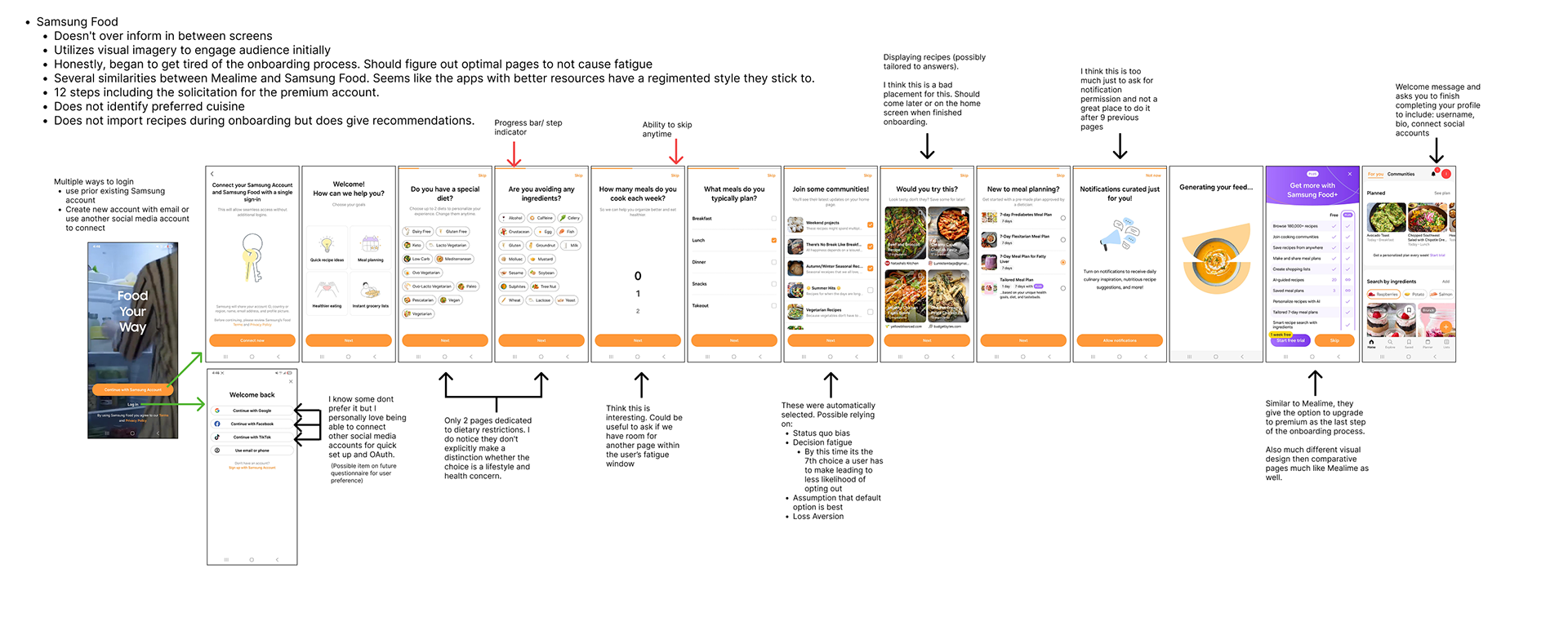
-Samsung Food (pictured below): Biggest Competitor. Does not identify preferred cuisine or import recipes, no gamification, 12 steps total
-Paprika Recipe Manager 3: No onboarding process
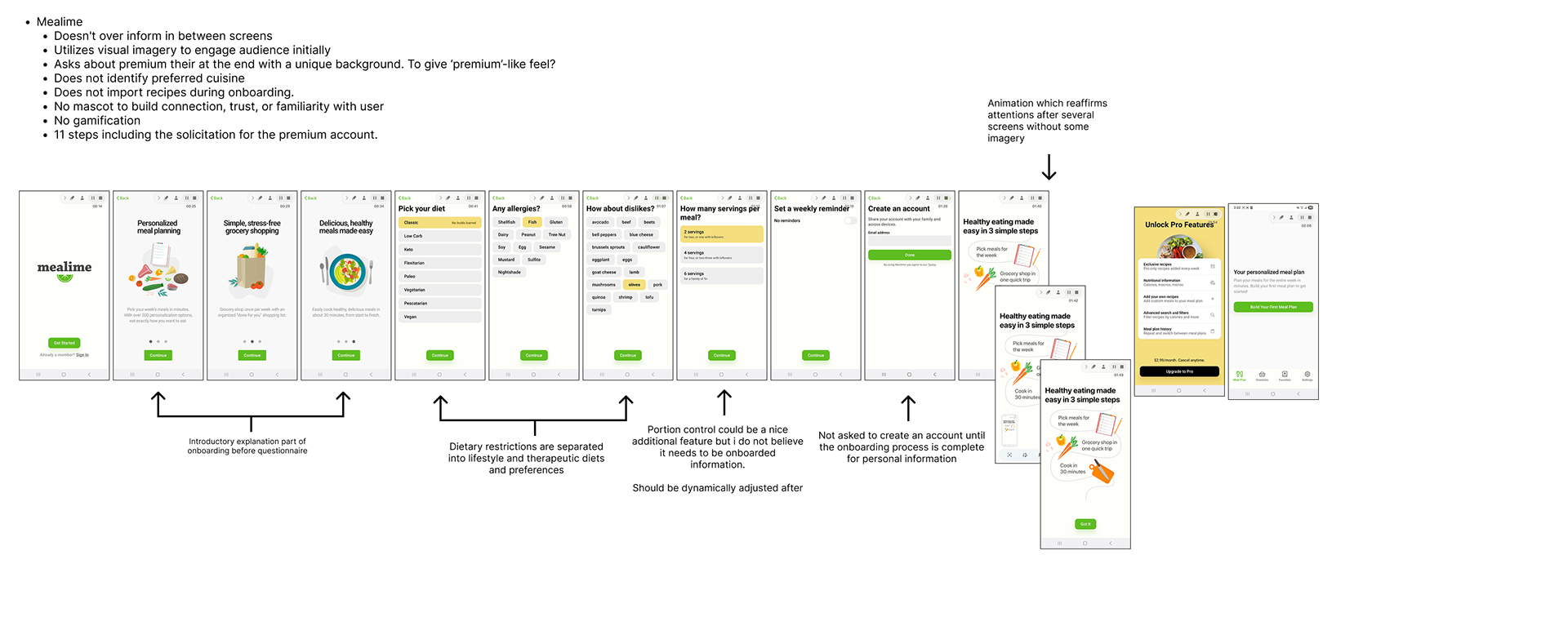
-Mealime (pictured below): Biggest Competitor. Does not identify preferred cuisine or import recipes, no gamification, 11 steps total.
-Recipe Keeper: Does not identify preferred cuisine or import recipes, no gamification, only 4 steps
-Plan to Eat: Does not identify preferred cuisine or import recipes, no gamification
-Samsung Food (pictured below): Biggest Competitor. Does not identify preferred cuisine or import recipes, no gamification, 12 steps total
-Paprika Recipe Manager 3: No onboarding process
-Mealime (pictured below): Biggest Competitor. Does not identify preferred cuisine or import recipes, no gamification, 11 steps total.